


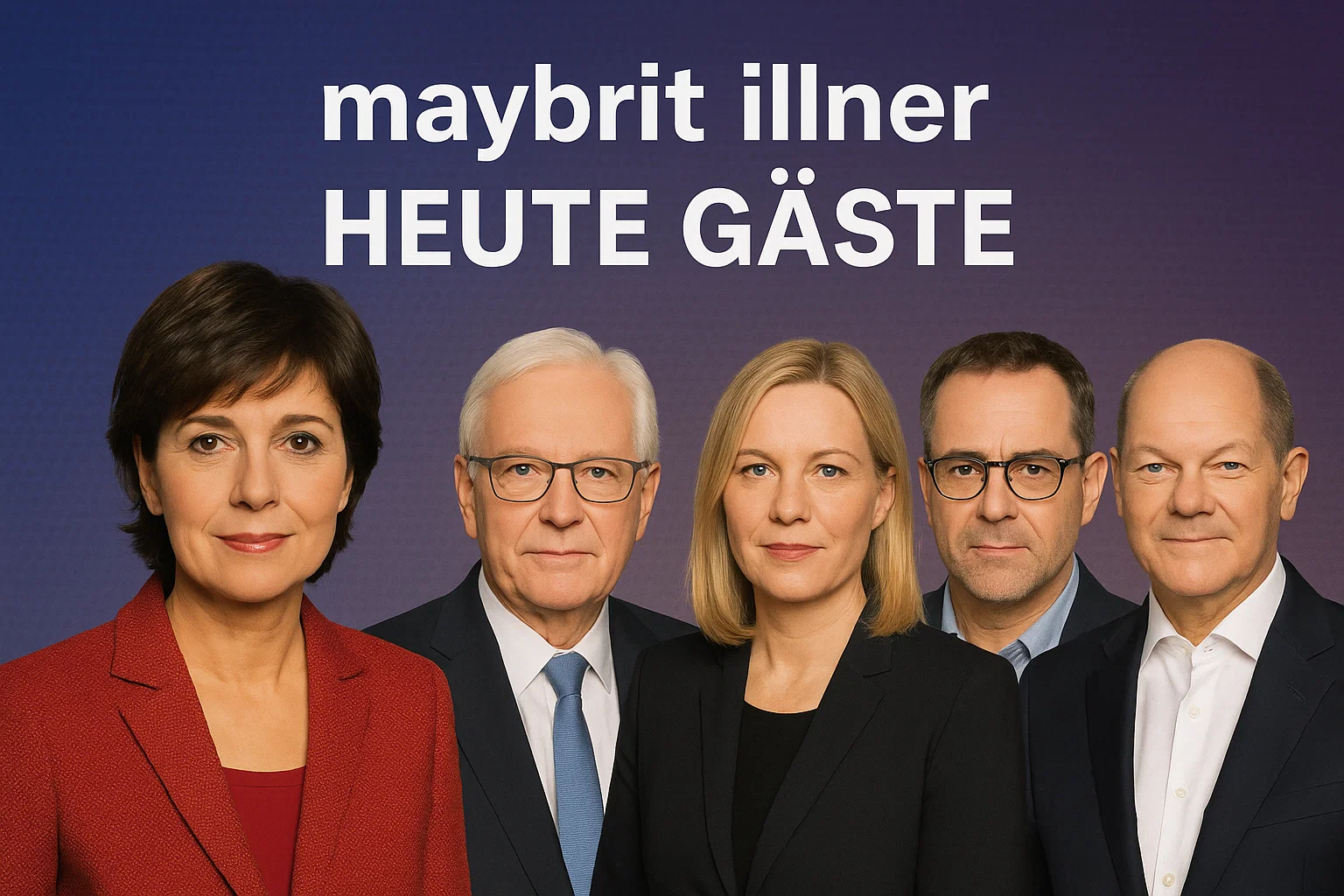
Every Thursday evening, a significant portion of the German political landscape and its engaged public turns their attention to a single television screen. The show is “Maybrit Illner,” and the question on everyone’s lips is a simple one: “Maybrit Illner heute Gäste?” – “Who are Maybrit Illner’s guests tonight?” This query is far more than just a glance at a TV schedule; it is a barometer for the nation’s political and social climate. The selection of guests on “maybrit illner heute gäste” signals which topics are burning issues of the week, who the key players are in a given debate, and what kind of discursive battle the audience can expect to witness. The program has cemented its status as a central arena for German political discourse, a place where ministers are challenged, experts are heard, and opinions truly clash.
Understanding the dynamic behind “Maybrit Illner heute Gäste” is to understand a key mechanism of German public debate. The show is not merely a passive reflection of the news; it actively shapes it. The discussions that unfold in the ZDF studio often spill over into front-page headlines, social media storms, and parliamentary discussions the next day. For anyone with an interest in the inner workings of German politics, media, and society, knowing who is sitting at that iconic round table is essential. This article will serve as your comprehensive guide. We will explore the art of the guest list, the unique style of Maybrit Illner herself, the anatomy of a typical show, and why this particular format has become such an indispensable institution. We will decode what it means when certain faces appear and others are absent, and how the interplay between them creates television that is both informative and unmissably dramatic.
The Art of the Guest List on Maybrit Illner
Crafting the guest list for a show like “Maybrit Illner” is a delicate and strategic art form. It is a weekly puzzle where the pieces are politicians, experts, and public figures, and the picture they form is the intended narrative of that evening’s debate. The producers and Maybrit Illner herself do not simply book the most famous names available. Instead, they engage in a complex curation process designed to ensure a dynamic, multi-faceted, and, most importantly, contentious discussion. The goal is never a polite consensus; it is a productive clash of perspectives. When viewers ask, “Maybrit Illner heute Gäste?” they are implicitly asking about the balance of power in the upcoming debate. Will the government side be well-represented? Who will voice the opposition’s critique? Is there a wildcard, an unexpected guest who will challenge the established political players?
The composition of the panel is what transforms a simple topic into a compelling hour of television. A typical lineup for a show dealing with a major policy issue, such as energy security or migration, might include a high-ranking minister from the responsible department, a leading opposition figure ready to pounce on any perceived weakness, an academic economist or political scientist to provide data-driven context, and a journalist or think-tank representative to offer a more pragmatic or critical view. This mix ensures that no single argument goes unchallenged. The minister must defend their policy not just against political opponents, but also against empirical data and real-world practicalities. This multi-front confrontation is the engine of the show. It prevents the discussion from becoming a sterile, party-political talking-points exchange and elevates it to a genuine search for the nuances and trade-offs inherent in any complex issue.
The Power of the Wildcard Guest
One of the most thrilling elements for regular viewers is the occasional inclusion of a “wildcard” guest. This is someone who is not a career politician or a usual pundit, but whose presence is guaranteed to disrupt the expected flow of conversation. This could be a trade union leader during a debate on labor laws, a doctor from an overcrowded hospital during a discussion on healthcare, or a mayor from a community on the front lines of the refugee crisis. These individuals bring a raw, often emotional, and always authentic perspective that can leave even the most polished politician speechless. Their testimony, grounded in direct experience, carries a unique weight that pure political rhetoric cannot match.
The inclusion of such voices is a deliberate choice to ground the debate in reality. When a federal minister speaks abstractly about economic growth, a local entrepreneur speaking about their struggle with bureaucracy and supply chains can instantly reframe the entire discussion. This strategy makes the show more accessible and relatable to the average viewer. It answers the “what does this mean for me?” question in a direct and powerful way. The anticipation of such a disruptive presence adds another layer to the question “Maybrit Illner heute Gäste?” It’s not just about who is speaking, but about who might shatter the predictable patterns of political debate.
The Illner Method: A Host Like No Other
The guests are only half the equation. The other, arguably more crucial half, is the woman whose name is on the show: Maybrit Illner. Her method of moderation is the glue that holds the often-volatile panel together and the compass that guides the discussion through turbulent waters. Illner is not a loud, confrontational host in the classic talk-show sense. Her power lies in a unique blend of meticulous preparation, quiet authority, and a relentless, Socratic style of questioning. She does not need to raise her voice to control the room; her sharp intellect and command of the facts do that for her. Viewers tune in not just for the guests, but for Illner’s masterful orchestration of the debate. She is the conductor, ensuring every instrument in the orchestra is heard at the right time, while keeping the entire piece from descending into cacophony.
What sets Illner apart is her profound preparation. It is widely reported that she immerses herself in the topic of the week, consuming briefs, reports, and previous statements from her guests. This allows her to ask the second- and third-order questions that others might miss. She is not interested in soundbites; she is interested in uncovering contradictions, probing weaknesses in an argument, and pushing her guests beyond their rehearsed talking points. Her calm demeanor is deceptive. It creates an atmosphere where guests might let their guard down, only to be met with a follow-up question that cuts to the very heart of a policy’s flaw or a statement’s inconsistency. This style forces a level of intellectual honesty that is rare in political television.
The Balance of Fairness and Tenacity
A common praise for Illner is her fairness. While she is tenacious in her questioning, she is tenacious with everyone. A government minister will face the same rigorous cross-examination as an opposition critic. A popular public intellectual will be challenged just as firmly as a controversial figure. This even-handed approach is fundamental to the show’s credibility. The audience trusts that Illner is working in the service of the debate itself, not for any particular political outcome. Her goal is illumination, not persuasion. This trust is hard-earned and is a key reason why the show maintains such a high level of prestige and influence.
This balance is particularly evident in how she manages conflict. When discussions heat up and guests begin to talk over one another, Illner’s intervention is typically firm but calm. She allocates speaking time with precision, ensuring that quieter, perhaps more substantive, points are not drowned out by louder, more aggressive voices. She has a knack for rephrasing a complex or emotional point into a clearer, more focused question, thus advancing the discussion. This ability to distill chaos into clarity is the hallmark of a master moderator. It ensures that the audience at home can follow the argument, even when the guests are at their most passionate. The show’s value lies in this clarity, and it is a direct result of the Illner Method.
Decoding the Topics: From Crisis to Conversation
The choice of topic for each episode of “Maybrit Illner” is a direct reflection of the national and international agenda. There are no trivial subjects on this show. The producers select issues that are at a tipping point—ongoing crises, newly passed legislation, breaking international scandals, or simmering social debates that have suddenly boiled over. The topic is the battlefield upon which the guests, the Maybrit Illner Gäste, will wage their rhetorical war. It is always formulated as a provocative, direct question, such as “Are we paying ourselves into ruin?” or “Putin’s Russia – Is there still a way out?” This framing sets a clear, contentious tone from the very beginning.
The table below illustrates how the show’s topics have evolved to mirror Germany’s most pressing concerns over recent years:
| Time Period | Exemplary Show Topics | Reflected National Concerns |
| Migration Crisis (2015-2016) | “The Limits of Help – Is the Welcoming Culture Overwhelmed?” | National identity, integration, security, and social welfare systems. |
| COVID-19 Pandemic (2020-2022) | “Corona: Freedom or Command? How Much State Do We Need Now?” | Public health vs. civil liberties, state power, and economic survival. |
| Ukraine War & Energy (2022-2023) | “The Price of Freedom – Are We Ready for a Cold Winter?” | Energy security, military support, inflation, and geopolitical realignment. |
| Ongoing Domestic Issues | “Broken Republic? Why Nothing Works Anymore.” | Infrastructure, digitalization, bureaucracy, and general public frustration. |
This alignment with the zeitgeist is no accident. The editorial team possesses a keen sense for what matters to people now. They identify the issues that are causing anxiety, debate around dinner tables, and division within the government coalition. By placing these topics at the center of the national conversation, “Maybrit Illner” performs a vital function of public service broadcasting: it educates the citizenry and provides a platform for the democratic process to play out in real-time.
The Anatomy of a Typical Show
While each episode is unique, a successful installment of “Maybrit Illner” often follows a recognizable rhythm. It begins with a short, powerful introductory film that lays out the topic, often using stark imagery and data to establish the stakes. This film serves to immediately engage the viewer and provide the essential context for the debate to come. As the camera pans to the studio, we see the host and the guests seated at the round table—a setup that implies equality and direct confrontation. Illner then opens the discussion with a direct question, usually to the guest whose position is most central to the night’s debate.
From there, the conversation unfolds in waves. Illner skillfully guides it from one aspect of the topic to another, ensuring all facets are covered. She will pose a question to one guest, then immediately turn to another for a counterpoint. The most memorable moments are often the spontaneous clashes between guests—when a minister’s defense is met with a sharp, factual rebuttal from an expert, or when a personal story from a non-politician exposes the abstract nature of a political argument. Throughout it all, Illner is the steady hand on the tiller. In the final segment, she often turns to broader, more reflective questions, asking guests for their prognosis or their recommended path forward. The show typically ends without a neat resolution, which is its most honest feature. It reflects the reality that the complex problems of our time are not solved in a 60-minute television program, but that the process of debating them openly is a necessary part of finding solutions.
The Cultural Impact of Maybrit Illner
The influence of “Maybrit Illner” extends far beyond its 60-minute broadcast slot on ZDF. It is a show that generates what media scholars call “echoes”—its discussions are amplified and continued across other media platforms, most notably on social media. Even before the show airs, the announcement of the Maybrit Illner heute Gäste becomes a topic of discussion on platforms like Twitter (X). Political insiders, journalists, and the engaged public speculate on what the chosen panel composition might mean for the upcoming debate. Key moments from the show, whether a particularly effective argument, a stunning gaffe, or a heated exchange, are clipped and shared online within minutes, often becoming viral content.
This second life of the show is crucial to its role in the public sphere. It allows for a much wider audience to engage with the content, even if they did not watch the original broadcast. The hashtag #Illner trends regularly on German Twitter, serving as a real-time public living room where thousands of users comment, critique, and add their own perspectives to the televised debate. This transforms the show from a one-way broadcast into a participatory event. The program doesn’t just report on the national conversation; it actively fuels and structures it for days to come. Politicians and their teams are acutely aware of this. A strong performance on “Illner” can bolster a politician’s reputation for competence and quick-wittedness, while a weak one can dominate negative news coverage for the following week.
A Pillar of German Democracy
In an era of fragmented media, misinformation, and political polarization, a show like “Maybrit Illner” serves a function that is more important than ever. It is a centralized, trusted arena where conflicting ideas are forced to engage with one another under the guidance of a rigorous and fair moderator. It provides a common set of facts and arguments from which a diverse public can form their opinions. Unlike the algorithmically driven echo chambers of social media, “Maybrit Illner” deliberately brings opposing views into direct contact. This does not always lead to persuasion, but it does foster a form of understanding and exposes the weaknesses in one’s own arguments.
The show is, in many ways, a practical enactment of democratic principles. It demonstrates that democracy is not just about voting every few years, but about the constant, often messy, process of debate, negotiation, and compromise. By giving a platform to a wide spectrum of voices—from government insiders to grassroots activists—it reinforces the idea that all these perspectives have a right to be heard in the public square. The enduring popularity and authority of the program are a testament to the public’s hunger for this kind of substantive, well-moderated discourse. It is a bulwark against the simplification of complex issues and a celebration of the messy, complicated, and essential nature of democratic deliberation.
How to Engage with the Show Like a Pro
For the casual viewer, tuning into “Maybrit Illner” can be an enriching experience. But for those who want to move from passive watching to active engagement, there are ways to deepen your understanding and get more out of each episode. The first step, of course, is to find out the Maybrit Illner Gäste and the topic for the evening. This information is usually released by ZDF on the day of the broadcast, often in the morning, via the show’s official website and its social media channels. Knowing the guest list in advance allows you to anticipate the lines of conflict. A quick search on the guests, especially the non-political ones, can provide valuable background on their expertise and typical positions, allowing you to better contextualize their arguments during the show.
While watching, try to pay attention not just to what is being said, but how it is being said. Observe Maybrit Illner’s technique: notice the specific phrasing of her follow-up questions and how she subtly steers the conversation back on track when it drifts. Watch the dynamics between the guests. Who is avoiding eye contact with whom? Who is using data effectively, and who is relying on emotional appeals? This meta-perspective turns the show from a simple debate into a fascinating case study in communication, rhetoric, and media production. Following the simultaneous discussion on social media, particularly using the official hashtag, can also provide a real-time “second screen” experience, offering a raw feed of public reaction that contrasts with the polished discussion in the studio.
Beyond the Broadcast
The engagement doesn’t have to end when the credits roll. The full episode is almost always made available in the ZDF Mediathek shortly after the live broadcast ends, allowing you to re-watch key segments. Many newspapers and online news portals publish analyses and summaries of the show the next day, often with a focus on who “won” the debate or which moment was most defining. Reading these analyses can help you solidify your own thoughts and see perspectives you might have missed. Furthermore, keeping a mental note of the guests who impressed you is a great way to build your own personal list of credible voices on specific topics. If a particular economist or journalist made compelling points on the energy crisis, for example, you can seek out their other writings and interviews, using the show as a curated gateway to deeper expertise.
Ultimately, engaging with “Maybrit Illner” is an active exercise in citizenship. It is an investment in understanding the forces that shape your country and your world. By moving from simply asking “Maybrit Illner heute Gäste?” to a deeper analysis of the guests, the topic, and the dynamics of the debate, you transform yourself from a spectator into an informed participant in the democratic process.
Conclusion
The simple question, “Maybrit Illner heute Gäste?” opens the door to one of the most substantive and influential forums in German media. It is a query that goes beyond mere curiosity about a TV program; it is an inquiry into the state of the nation’s debate. The show’s power stems from a powerful alchemy: the careful curation of a diverse and conflicting panel of guests, combined with the masterful, tenacious, and fair moderation of Maybrit Illner herself. Together, they tackle the most pressing issues of the day, not with the goal of providing easy answers, but with the more valuable aim of illuminating the complexities and trade-offs involved.
In a fragmented digital landscape, “Maybrit Illner” remains a pillar of reasoned, multi-perspective discourse. It is a weekly reminder that democracy is a conversation—often a loud, messy, and difficult one—and that this conversation is essential for a healthy society. The show’s enduring relevance is a testament to the public’s appetite for intelligence over spectacle, for substance over soundbites. So, the next time you find yourself wondering about the guests on Maybrit Illner tonight, know that you are tapping into a vital current of German political life, one Thursday evening at a time.
Frequently Asked Questions (FAQ)
Who are the guests on Maybrit Illner tonight?
The list of guests for the upcoming “Maybrit Illner” show is typically announced by ZDF on the day of the broadcast. The most reliable way to find out the Maybrit Illner heute Gäste is to check the official “Maybrit Illner” section on the ZDF website or the show’s official social media profiles, such as its X (formerly Twitter) account. German news portals and TV magazines also frequently publish the guest list in their daily program previews.
How can I watch old episodes of Maybrit Illner?
Virtually all past episodes of “Maybrit Illner” are available for streaming on the ZDF Mediathek, the network’s official online video library. The Mediathek is accessible via its website and through dedicated apps on smart TVs, smartphones, and tablets. Episodes are usually available shortly after the live broadcast concludes and remain online for a limited period, often several months, depending on licensing rights.
What makes the selection of Maybrit Illner Gäste so special?
The selection of Maybrit Illner Gäste is considered special due to its deliberate and strategic curation. The producers aim for a balanced yet confrontational mix that includes high-ranking politicians from government and opposition, leading academic experts, and often a “wildcard” guest with direct, real-world experience of the topic. This composition is designed to prevent an echo chamber and instead foster a genuine, multi-fronted debate that challenges every perspective presented.
How does Maybrit Illner manage to control such heated debates?
Maybrit Illner controls heated debates through a combination of immense preparation, a calm but firm demeanor, and a Socratic questioning style. She is known for her deep research, which allows her to challenge guests on the specifics of their arguments. Her quiet authority commands respect, and her even-handed approach ensures that no single guest is unfairly targeted. She strategically allocates speaking time and rephrases chaotic exchanges into clear, focused questions to maintain order and clarity.
What is the best way to follow the discussion about the show on social media?
The best way to follow the social media discussion is to use the official show hashtag, which is typically #Illner, on platforms like X (Twitter). By searching for this hashtag before, during, and after the broadcast, you can access a real-time feed of comments, critiques, and reactions from journalists, politicians, experts, and the general public. This provides a lively “second-screen” experience that complements the televised debate.
